
What Is A Finish File?
Hello hello! I hope you’ve been enjoying these more educational posts :) Today’s is going to focus on FINISH FILING! Which is a very important step you can take during the manicure to prevent free edge lifting. This process also goes hand in hand with Armoring the Free Edge - so make sure you read that post too if you haven’t yet.
Finish filing is kind of a controversial topic because inherently it sounds like something that would cause the gel to lift away from the tips of the nails, but in reality, it does the opposite! But only when done correctly and with the correct products.
What is finish filing?
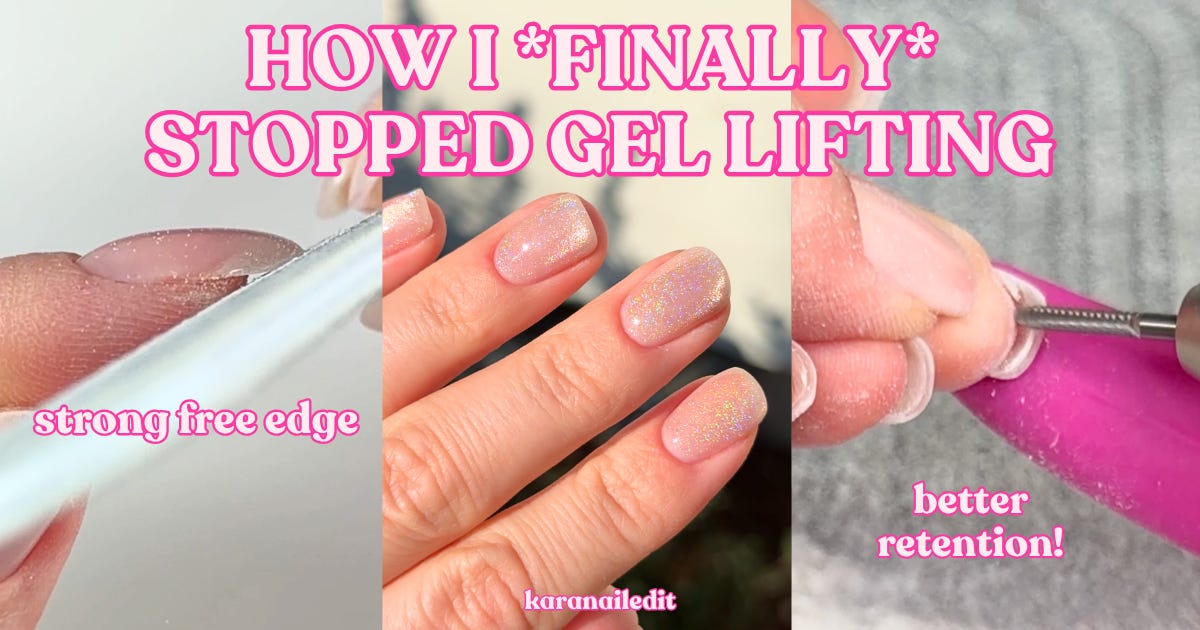
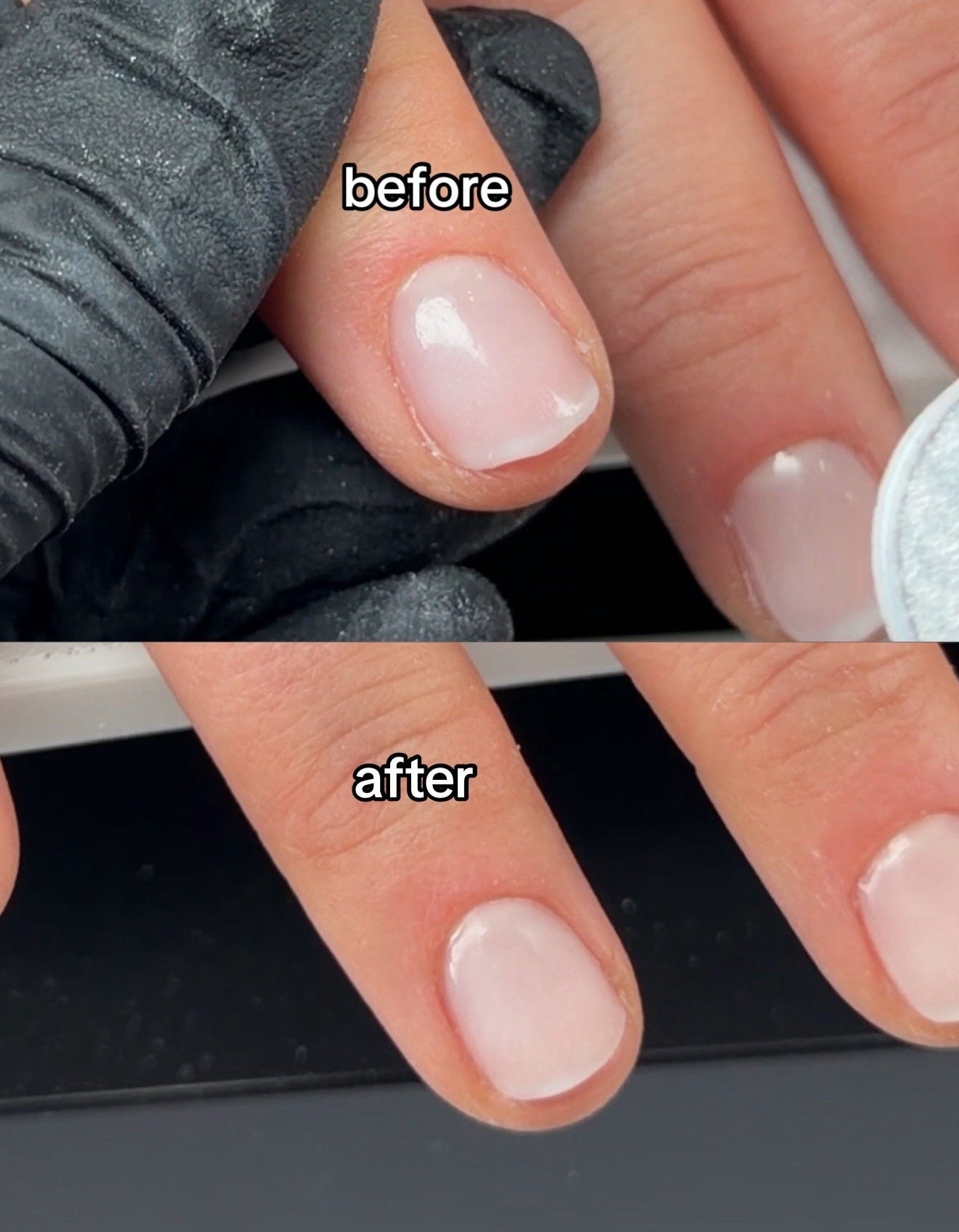
Finish filing is when you file the natural nail a little bit to remove it and tuck it underneath the builder gel. The way that you file the nail is important because we want to file it at a 45 degree angle to bevel the edge so it’s nicely tucked underneath. If you only file directly perpendicular to the nail, it can cause lifting because you aren’t actually tucking the natural nail, you are just making it even with the gel.
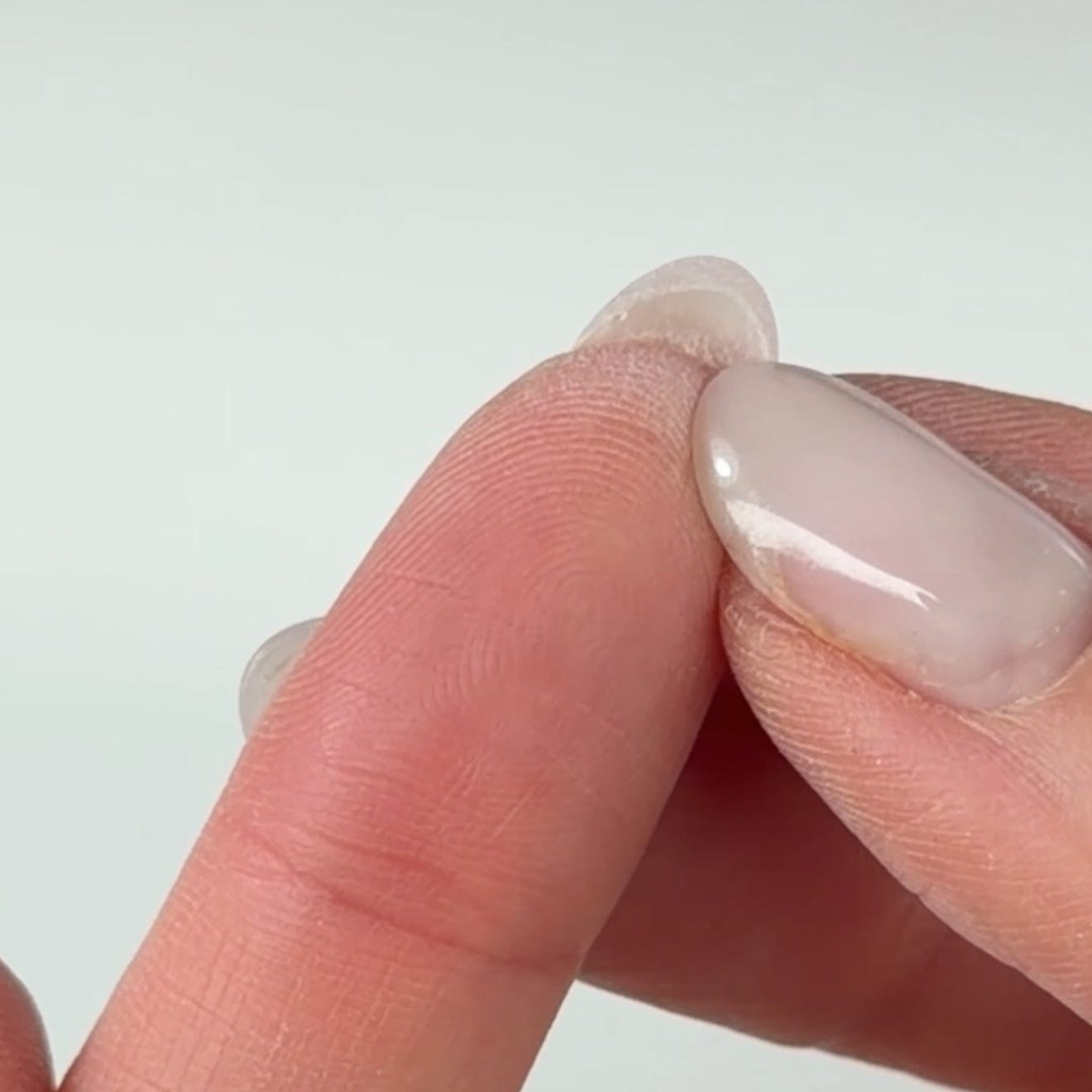
This process is only done when using builder gel, which shrinks a little bit as it cures. Because of this shrinkage, it can leave the tip of the natural nail exposed without any builder gel covering it.
Why do we do it?
Simple answer: to strengthen the free edge. A strong free edge = better retention with no lifting.
The natural nail is naturally bendier and more flexible than builder gel (hence the reason why we use builder gel as a strong protective layer over natural nails!), so if we leave the natural nail exposed at the tip, it can bend and flex and lift apart from the builder gel causing lifting and separation at the tips. Tucking the natural nail underneath the builder gel prevents this entire situation from happening!
It also makes your nails look more finished and the shape looks precise and crisp!
When should you finish file?
I only really recommend doing a finish file when you use builder gel, either semi-hard or hard because it can withstand being filed and holding up the shape even with the nail being filed away.
Read my post about builder gel and the different types here!
When should you NOT finish file?
If you are only using soft gel (i.e. soft gel base coat, gel color and gel top coat), the products may not be strong enough to withstand being filed and the product can lift and break and chip.
If you want to touch up the shape after applying soft gels, I would recommend using a high grit file like 240 so that you aren’t causing micro tears in the nails, but I can’t guarantee it won’t cause lifting.
Where does it fit into the routine?
This is up to you and the routine you like to do, but you’ll do it after you apply builder. I personally like to do it after the builder gel is cured, because I will shape and do some surface filing at the same time and it’s nice to file everything at once.
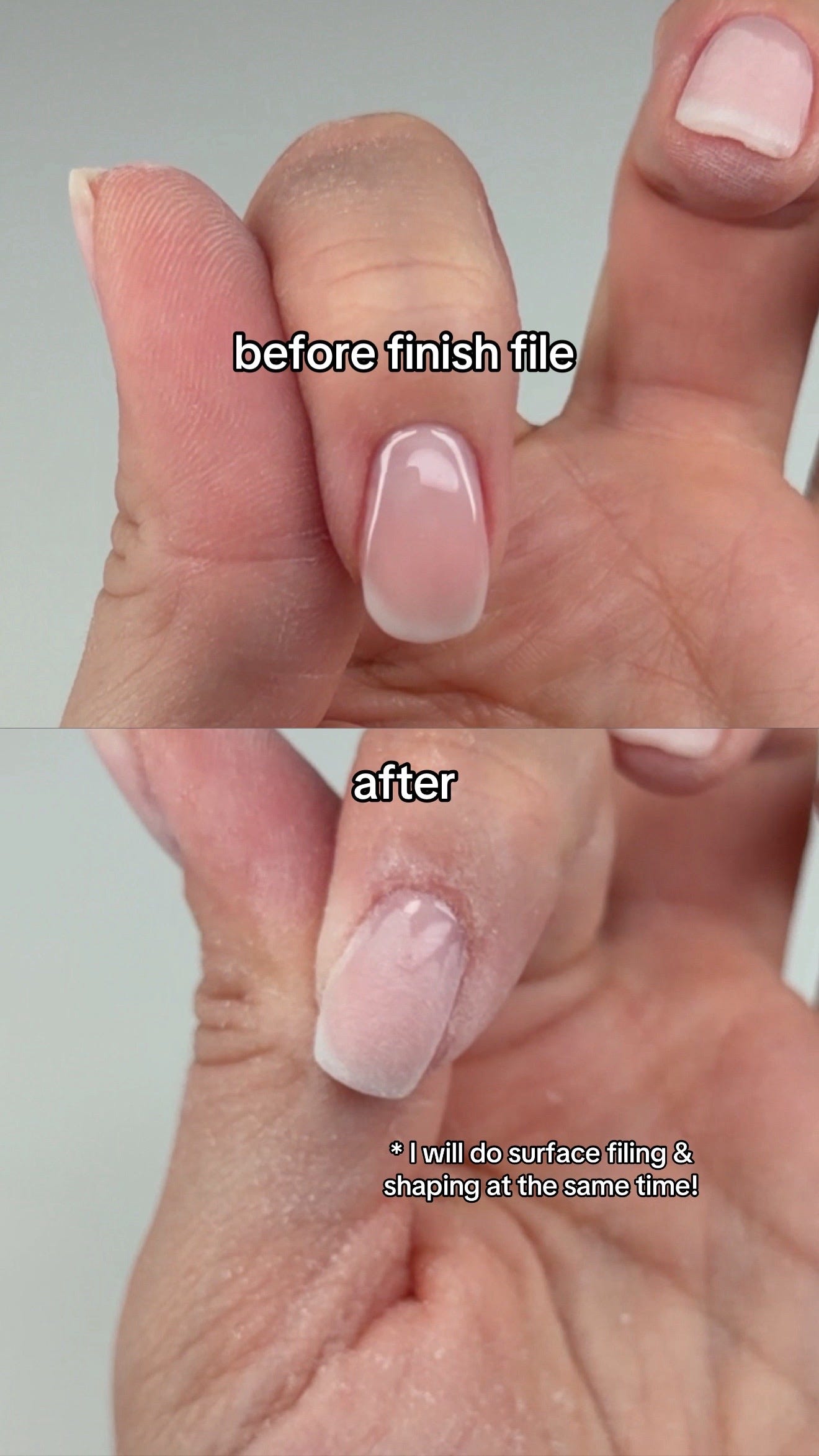
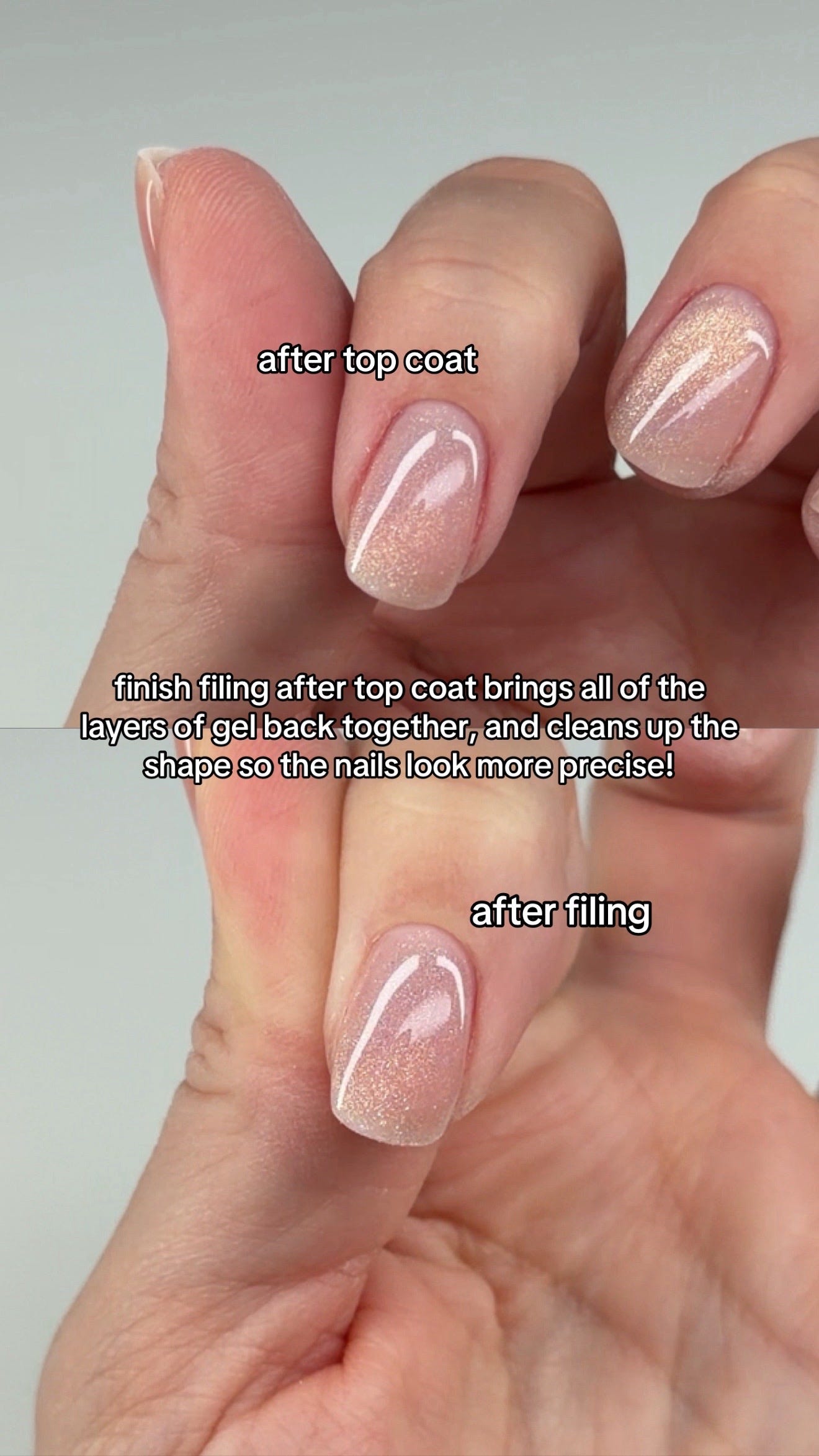
I also like to touch up the shape and do a tiny finish file after top coat, so I will essentially do it twice, but the main one where I’m really doing all of the work is after builder application. The file after top coat takes me less than a minute.
If you don’t surface file and want to do the shaping and finish file after top coat, that’s a nice option too so that you only need to file once!
What tools do we use for finish filing?
This also depends on the length and shape of the nails. For all nails, I will use a file (usually 150 or 180 grit) and for some lengths and shapes, I’ll use an e-file bit. My favorite one is the Under Cleaner from Erica’s! It’s very thin and narrow which makes it easy to use underneath most nails and helps create a nice C shape.
It’s easier to use a hand file under round or almond nails, but when you enter square or soft square territory, sometimes it’s impossible to file the entire nail and this is where an e-file bit can come in handy!


Let’s address some FAQs:
These are some common questions I get whenever I share this process!
Q: So you don’t cap the nails with gel?
A: No! Since I am filing the nails after applying product, and also after top coat, there isn’t a need to cap the nails with polish. I actually wouldn’t recommend doing it anyways, because you could add a glob of gel near the top and thicker areas of gel can cause lifting.
Q: Doesn’t it ruin your nails if you file it away? I want them to grow them, not shorten them.
A: It does shorten them a bit, but the amount is negligible compared to the amount that your nails will grow during the few weeks that you’ll have the harder gel on them. And if your gel doesn’t lift and you have great retention, it’s better for your nail growth in the long run.
Q: I do this and my nails are still lifting.
A: There is probably some other factor contributing to your lifting. Read this post here for some tips. I highly recommend my Advanced Gel Manicure Class which focuses on how to prevent lifting and how to apply products so it doesn’t happen too!
Also, this is only meant to be done on harder gels. If you’re using only soft gels, your gel will likely lift or chip. I mean it when I say I do this every single manicure I do and I never have lifting from the free edge, not once!
Q: Why do you do it after the topcoat too?
A: Like I mentioned, gel shrinks or changes shape a little bit when it cures. So filing at the very end of the manicure when you’re done with applying gel will make all of the layers come back together for a more even look and to ensure there’s no natural nail sticking out from gel shrinkage. It also makes the shape look precise and crisp!
Do you have any other questions about this process? Let me know!

Are you interested in my certification classes?
I am gearing up to host some branded certification classes this summer! If you’re interested in learning more about my Kokoist Double Certification, Nail Thoughts with Erica’s ATA E-Filing Double Certification and NEW Kinetics Certification, enter your email here on this form and I’ll send you a note with more info when they’re ready :) Ps - anyone on the waitlist will receive a special discount when enrolling in the classes!